

Narrative
Smallholder farmers represent one of the most powerful levers we have for addressing climate change and global food security, and yet they remain largely absent from the conversations that shape agricultural policy, donor support and investment. Through writing, publishing, and advocacy, we work to change that.
From the Regenerative Front Lines (Substack)

In-depth articles at the intersection of regenerative agriculture, smallholder farming, and global food systems. Written by Hugh Locke and various guest co-authors, the articles draw on Impact Farming's research, fieldwork and policy engagement to examine issues including carbon credits, natural asset investment, and the broader question of what regenerative agriculture should ultimately aim to achieve. The goal is to inform, challenge assumptions, and help shape a movement that keeps smallholder farmers at its center.
Click on images below to read the articles, not that they are all free and require no subscription.


Whole Earth Farming
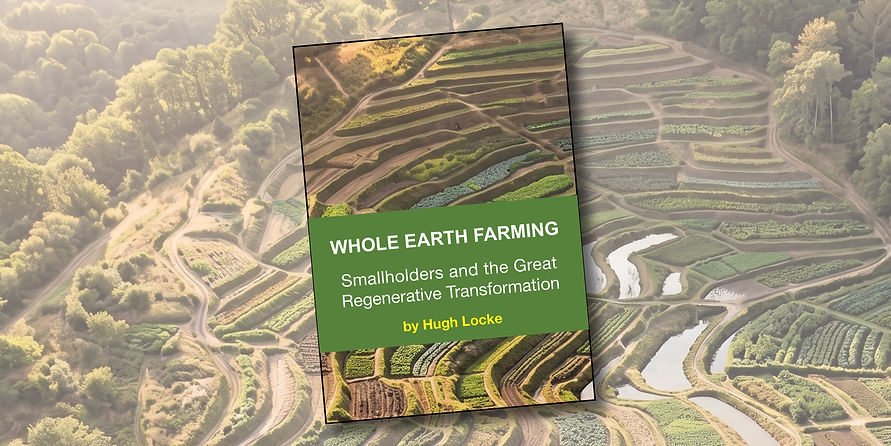
In his new book Whole Earth Farming: Smallholders and the Great Regenerative Transformation – to be published in September, 2025 – Hugh Locke introduces us to the one quarter of humanity who have been hidden in plain sight for generations. He takes us to the fields, the neighborhoods and the communities where 475 million smallholder farming families have been quietly feeding the world for generations while remaining almost entirely invisible.
Their story is extraordinary, their potential transformative, and the moment for both has finally arrived. At the heart of that moment is the power of big ideas. Just as two concepts from 18th-century England converged in the 1960s to catalyze the Green Revolution that transformed global food production, Hugh argues that a new convergence of ideas is now underway, one with the potential to be even more transformative. He makes the audacious case that half of the world's smallholder farmers, working just twelve percent of global arable land, could produce all the additional food the world will need by 2050 while actively combating climate change.
Written for anyone interested in food, farming, climate, justice, or the future of life on this planet, Whole Earth Farming is both a compelling manifesto for an urgently needed transformation and a practical roadmap for making it real.
Every food crisis I have seen, from Haiti to Ukraine to Gaza, has taught me the same lesson: the people who hold communities together are the ones who feed them. Hugh’s book builds on that truth with a clear and urgent call to action. Farmers, as the bridge between people and the land we inhabit, have the power not only to produce food, but to strengthen local economies and nourish our shared future. I have seen enough to know this is not just an idea. It is already happening. Read this book. Then do something.
– José Andrés, Chef, Humanitarian, and Founder of the Global Food Institute at George Washington University
Tanama Project

Created by Haitian comic book artist Anthony 'Thony Loui' Louis-Jeune and developed in partnership with the Smallholder Farmers Alliance, Tanama follows a young supershero — daughter of smallholder farmers — who draws her powers from the forest. Woven through both published issues are themes of environmental stewardship, tree planting, and gender equality. When COVID-19 struck Haiti, Tanama was mobilized for a national prevention campaign that reached an estimated three million people. The United States Library of Congress has requested both issues for its permanent collection. Tanama demonstrates that transforming how people understand their relationship to land and farming is not only the work of agronomists — it is also the work of artists.